By Henry Mutebe
Recently someone powerfully coined the experience of being a Ugandan entrepreneur into the most appropriate and relatable expression, when they said that “E Kampala, business esoka ku kukwegezamu? Esooka kwagala kukutta! ”—literally translated as Ugandan business will attempt to first kill you. In many respects, reading New Vision today in search of information became an experience of misinformation.
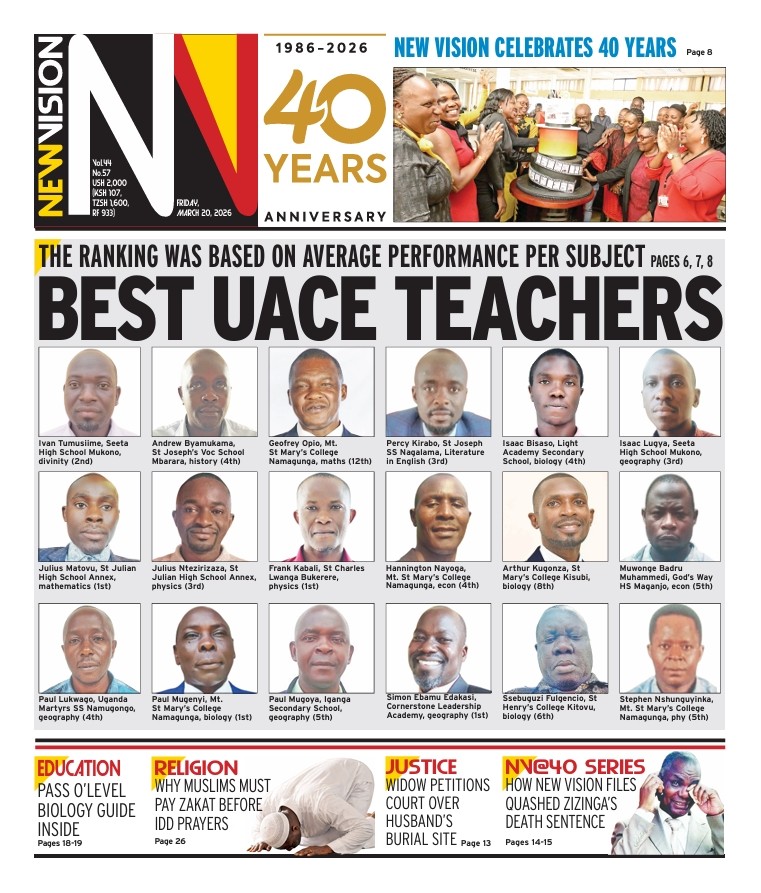
Yesterday 20th March, New Vision carried the headline “BEST UACE Teachers” and paraded an all-male pictorial of 21 faces, mostly from top schools, without any effort to deeply analyse or even question beyond these names, faces, and schools.
Now, I am not against the persons mentioned and I sincerely congratulate them on the achievements of their students- our children. There is no doubt these are very good teachers. But my issue is with the poor reporting exhibited in that article. The headline is misleading and feeds into a ceremony and culture of “best so and so,” which narrows the analysis of very serious issues that would otherwise help inform and support policy.
I cannot express the amount of rage I feel at this display of narrow reporting—and the missed opportunity to dig into issues that would actually help improve things.
First of all, who tells the editor or reporter that the result of a Senior Six student is the result of the effort of an individual subject teacher? It is very lazy reporting to simply pick the subject teacher of a Senior Six class and call them the best. That presupposes that Senior Six exams (UACE) are only based on what was taught in Senior Six. That is fundamentally wrong.
Who should teach the editor that UACE exams are based on assessment of a wide range of topics accumulated over years of learning in a particular level, and so it is methodologically wrong to attribute this performance to a single subject/class teacher?
This is what scholars of communication call framing—where a story is presented in a way that already decides what the reader should see as important. By choosing to frame “best teachers” as those attached to top-performing students at the final stage, the newspaper quietly defines excellence in a very narrow and misleading way. The public is not just being informed; they are being guided—almost instructed—on what to believe is “best.”
How about measuring excellence of a teacher by looking at how much a student came with into the level (what did they get at Ordinary Level?), and how much transformation has happened? What is the input and output?
Many of the top schools get students who already come with strong grades—they are low-maintenance, high-yield students. The input of a teacher in such contexts is often minimal compared to schools that are working with students who start from much lower levels. And that’s not to say that these teachers dont do a good job, but it can be misleading.
Also, many of these students come from middle-class or high-income families—just by looking at the schools mentioned. These are structural advantages. But the article erases these realities and instead presents success as if it is purely the result of individual teacher effort. This is a dangerous simplification that ignores how systems actually work.
Secondly, one would have wanted to ask: what is “best”? What are the dimensions of “best”? It would have been important to interrogate this. Even something as basic as gender—were there no female teachers who performed well enough to be recognised? Or were they simply not seen? The silencing of is so loud here.
When an entire spread shows only men, it is not just coincidence—it becomes a form of gendered silencing, where the contributions of women are rendered invisible. Over time, this shapes public perception about who is competent, who is excellent, and who deserves recognition. It quietly tells society that excellence looks male. You would have done us good if you went further to look for the nearest female teachers- and if they do not exist, also point that out.
For example, a school like Iganga Secondary School, which also has students with visual impairments but still posts very strong results—why don’t we also look at such schools and dignify that kind of “best”? Do the editors appreciate what goes into teaching a student with a visual impairment? How about teachers working in prisons, in refugee settlements, in hard-to-reach areas, under very difficult circumstances? That is where real transformation is happening. How about exploring these type of ‘bests’ too?
Where are the female teachers? How about unpaid teachers, teachers on Islands who use boats to cross waters to keep students in school? There would have been a bigger pool of besties for us to look at than the subject teacher of a top Kampala/Wakiso school. There are many teachers who are transformative and who receive the poorest of the poor and work with them to post good grades. This too would be interesting to look at.
But these stories are missing. And when they are missing, it is not neutral. It reflects what thinkers like Foucault would call a dominant discourse—a way of seeing and talking about the world that privileges certain realities while excluding others. In this case, the discourse of “best” is captured by elite schools and already advantaged learners.
Plus, this culture of “besting” everything bastardises how parents and the public think. It reinforces the idea that what is mentioned in the newspaper is automatically the best school or teacher. It becomes a self-reinforcing cycle of visibility and privilege. Then parents flock those schools. The following year, the performance tanks.
One would have done better by assessing a matrix of variables and exploring beyond just results to objectively identify good teachers and schools. There are many dimensions that could have been explored.
Also, the results of Ugandan examinations are usually very funny and unpredictable. One would want a researcher to study trends of these schools and help us understand these variations. One year a school performs exceptionally well, the next year it drops significantly. You can not see any clear pattern. What has happened? Do teachers migrate? Did the assessment change? Is the examination process consistent? Or are there other underlying issues? Its just hard to believe the performance we post.
The lack of any clear pattern is visible and, frankly, suspicious. There is something fundamentally wrong that needs deeper interrogation. Universities and researchers should take interest in studying this phenomenon because it does not make sense.
But more importantly, this kind of reporting denies the public an opportunity to understand “best”—the what, the why, and everything in between. Instead, it reduces a complex system into a simplistic and misleading narrative.
This is what is called epistemic injustice—where the public is denied the tools and perspectives needed to properly understand an issue. The article does not just fail to inform; it actively limits understanding by excluding alternative ways of thinking about excellence.
What we are seeing is the promotion of a false narrative—that a systemic outcome can be attributed to an individual at the final stage—while ignoring the many factors that influence that result: prior learning, other teachers, school environment, and socio-economic dynamics.
For example, it would have been more meaningful to identify the most transformed students—those who entered A-Level with lower grades and emerged at the top. That would tell us something about teaching, effort, and systems that work.
There were many angles to this story. They were either ignored or deliberately omitted.
And so we must ask: who is being silenced in this reporting? Whose stories are not being told? Whose excellence is not recognised?
New Vision can and must do better. Because when the media frames issues poorly, it does not just misinform—it shapes how society understands success, how parents make decisions, and how policymakers prioritise interventions. And that is dangerous.
Because like that Kampala business, when systems that are supposed to support you instead mislead you—they slowly begin to kill the very thing they are meant to build.