By Henry Mutebe
As someone who works in public health but is not a medical doctor, I occasionally get the chance of sitting in spaces where these health professionals discuss their work at a depth that many of us outside medicine rarely get to see. Every time I do, I come away with a new appreciation of the profession.
A few weeks ago, I attended a mortality audit involving a pre-term baby who had, sadly, passed. This particular experience left a lasting impression on me. For those who may not know what a mortality audit is, it is essentially a structured review of a death. In this case, it was a baby born prematurely who was referred from another health facility and later passed away despite the efforts made to save the child’s life.
What fascinated me was not simply the process itself, but the honesty, rigor, and depth with which it was conducted.
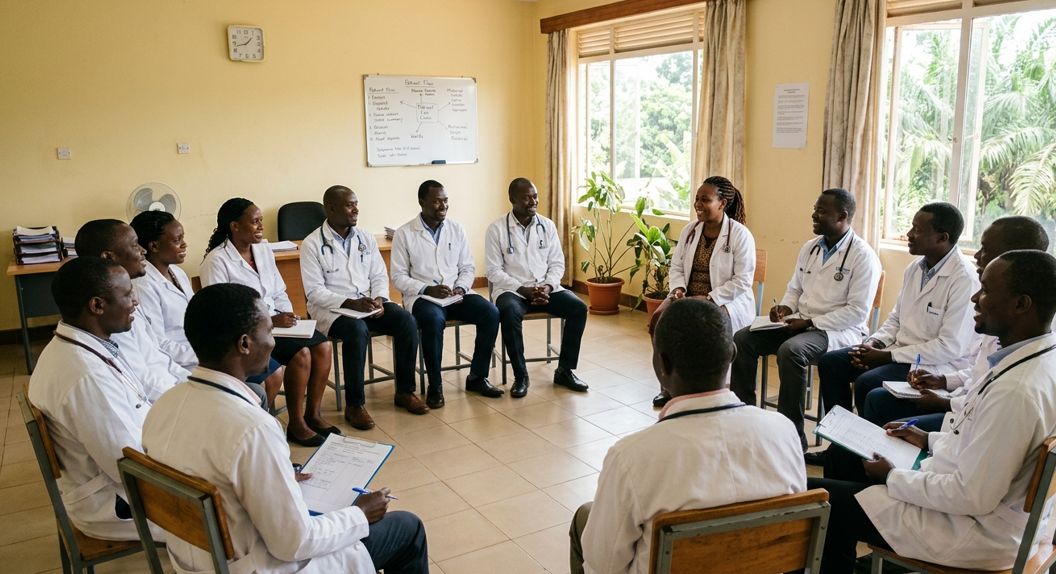
Let me paint for you a picture of what I saw. Basically, consultants/specialists, medical officers, interns, nurses, anesthetists, laboratory personnel, and other members of the care team sat in one room and then the case (the story of the child who had passed) was then presented in detail.
The presentation starts from the very beginning. Who was the patient? What was the mother’s history? What happened during pregnancy? Were there any risk factors identified during antenatal care? Where was the baby born? What was the condition of the baby at birth?
When was the referral made? How long did the transfer take? What condition was the child in upon arrival? What interventions were done? What medicines were given? What investigations were requested? What were the results? At what exact time did each of these things happen? And then the discussion begins.
The team goes through the case almost minute by minute. Could the diagnosis have been made earlier? Was the right treatment given? Was it given at the correct dose? Was it given at the correct time? Were the laboratory results accurate? Were they interpreted correctly? Were the machines functioning properly? Had the equipment been serviced?
Were oxygen levels monitored correctly? Were there delays in referral? Were there missed opportunities during antenatal care? Were warning signs overlooked somewhere along the patient’s journey? It is so detailed that nothing is taken for granted.
These guys question a lot of things. They asked so many things but that’s all I could, with my arts mind, remember
And there is a sense in which, despite the honesty with which its done, you feel like people are not looking for someone to blame, but they are looking for lessons. It was that method that got me hooked.
What struck me most was the extent to which the discussion was anchored in science, evidence, protocols, and guidelines. At every stage, people would ask: What do the guidelines say? Some Doctor would then state the guidelines on a certain dosage, procedure or issue. There is no gambling!
They would ask what is the recommended standard of care? Was the protocol followed? Was there any deviation from established practice? If there was, what was the reason? The discussion was not driven by opinions, seniority, or personalities. It is an examination of what was done mapped against what is recommended to be done.
The discussions were driven by evidence. There in that room, its science. They have absolute established guidelines and they do this with such relentless attention to detail. I found that profoundly impressive.
The level of care with which every step was examined was extraordinary. Tiny details that many of us would dismiss as insignificant were carefully scrutinized because in medicine, as I learnt during that meeting, sometimes the difference between life and death lies in what appears to be a small detail.
Death can be caused by a nurse who forget to wash their hands or remove the gloves used before. It could be one extra gram of a drug or a second late delivery of a drug that leads to a loss of life. So they are so careful with their stuff.
At one point during the discussion, I found myself asking a rather strange question: “Are these really Ugandan doctors?” Not because I doubted their competence, but because I was witnessing a level of rigor, discipline, and professional self-examination that many of us rarely get to see from the outside…and one that I wish was routinized in other professions or work.
When most of us interact with doctors, it is often in the rush and pressure of a ward, a clinic, or an emergency room. We see brief interactions. We see crowded facilities. We see the visible challenges of the health system.
What we do not often see are the hours spent reflecting, questioning, debating, learning, and holding one another accountable to professional standards. I felt very good knowing that these guys sit back and hold each other accountable.
As I listened, I realized that beneath the white coats was a group of professionals who take their responsibility very seriously. They were not simply discussing a case. They were measuring themselves against a standard. A standard of care. A standard of professionalism. A standard they have set for themselves and one they continually strive to improve.
From what I observed, nobody seemed satisfied with saying, “We tried our best.” They wanted to know whether their best was good enough. Whether the science was followed. Whether the guidelines were followed. Whether something could have been done better. Whether another life could be saved the next time. I found that deeply humbling.
In a country where we often focus on what is not working, I left that room with immense respect for the many health workers who quietly carry this commitment every day. It reminded me that excellence is often invisible to the public. Yet it is being practiced, nurtured, and defended in rooms like those, one difficult conversation at a time.
I also found myself reflecting on something else. Many of us only encounter doctors and nurses during moments of great anxiety. We arrive at health facilities worried, frightened, exhausted, and desperately hoping for good news.
Sometimes, because of the stress we are under, we can come away feeling that the doctors are distant, impersonal, or not caring enough. I have always felt this way- many times. But sitting in that room gave me a very different perspective.
For the first time, I was able to listen in on the conversations that happen after the crisis has passed. I was able to hear the seriousness with which people discussed the case. I was able to witness the honesty with which they questioned themselves and one another. I was able to see the value they attached to understanding exactly what had happened and it was deep, very deep.
At several moments, I found myself thinking about the parents who had lost that child. Part of me wished they could somehow hear that conversation, not because it would lessen their grief…nothing can erase that pain, but because they would hear something that many of us never get to hear.
They would hear a room full of professionals wrestling with difficult questions, searching for answers, examining every detail, and asking themselves whether anything more could have been done.
There was a profound sense of introspection in that room. There was humility. There was accountability. And there was, strangely, a kind of dignity being given to the departed child.
The child’s life mattered enough for dozens of professionals to stop, reflect, learn, and examine themselves not merely to understand what happened, but to ensure that future children benefit from the lessons learned. I found that incredibly moving.
What also struck me was the mentoring that takes place during these discussions. The senior consultants do not simply point out mistakes. They bring instinct. They bring judgment. They bring the wisdom that comes from seeing hundreds, sometimes thousands, of similar cases over decades.
Sometimes they quoted the guidelines. Sometimes they explained the science, and sometimes they shared those unwritten lessons that are difficult to find in textbooks but are acquired through years of experience caring for human beings.
The younger doctors listened, they asked questions and learned. And in that process, knowledge is passed from one generation of clinicians to another.
As I sat there listening, it felt surprisingly personal. What I had expected to be a technical review turned out to be something much more human. I thought these guys don’t care. I thought Doctors develop some sense of detachment with their patients. If you die, they move to the next patient.
But in that meeting, it felt different. It was a conversation about responsibility, learning and about about how to honour a life that was lost by making sure its lessons are not lost as well.
I was also struck by something else. In a strange way, I felt that the discussion gave dignity to the child who had died. That child’s life was not simply recorded as a statistic and forgotten. The loss became a source of learning that could improve the care of future children. I felt that the child’s story continued to matter and that the child’s life continued to teach.
As I sat there listening, I found myself wishing we approached many other aspects of our society in the same way. Imagine if every major road accident was subjected to the same honest audit.
I wish Ministry of Works, Ministry of health, Police, Scholars and community sit, and ask what exactly happened? Was the road properly designed? Were road signs visible? Were they obeyed? Was there adequate lighting? Was speeding involved? Were the vehicles roadworthy? Was the driver fatigued? Was emergency response timely? Had similar accidents occurred at the same location before? What lessons should be learned? What actions should be taken to prevent another death?
Imagine if every mob action, every public tragedy, every preventable disaster received the same level of reflection. Take the recent case involving the death of the young man Rugby player who was mobbed to silence.
Beyond the anger and emotion, there are important questions society should be asking. What happened? Why did it happen? What signals were missed? How did a crowd reach that point? What systems failed? What can communities, leaders, police, local authorities, schools, parents, and citizens do differently?
Too often, a tragedy happens and we move on. The same road remains dangerous. The same hotspot remains unmanaged. The same conditions remain unchanged. The same mistakes are repeated. And then we are surprised when the next tragedy occurs.
We rarely stop to learn, reflect and ask difficult questions.
One of the things I admired most from that mortality audit was the culture of learning. The medical profession seems to understand something many of us struggle with: that improvement begins with honest reflection. Not blame, shame, denial but reflection, learning, evidence and action.
I left that meeting convinced that if we institutionalized this culture of honest auditing and learning in more sectors of our society, we would save lives, prevent suffering, and become a much wiser nation.
Sometimes progress is not found in knowing all the answers. Sometimes it begins with having the courage to sit down together, examine the facts, respect the evidence, set aside our egos, and ask honestly: “What happened, and what can we learn from it?”
I left feeling very happy because, although from what I understood, there were missed opportunities at Ante-natal, where the issue of the child could have been picked, there was a sense in which Doctors felt a noble duty to have done their best, and that- introspection, was powerful and comforting.
This meeting was one of those good things you see and regain a sense of confidence in your community. So much happens in this country that is enough to make one just give up, but after that meeting, I felt that may be, just may be, many…in fact most of these medics actually love their job, they care about their patients and they hold each accountable. That, is a good thing. Proud of you Ugandan Medics and care teams.